
Speed to Lead: Win More Jobs as a Tradie
Tradies, Lead Generation, Automation
Speed to Lead: Why the First Tradie to Reply Wins More Jobs
In 2026, the Australian trade game is simple: the first HVAC, plumbing, or electrical contractor to respond usually wins the job. If your business is slow to reply to calls, texts, or web enquiries, you are leaving serious money on the table — every single day.
The brutal truth: speed to lead decides who gets the job
Homeowners and property managers do not sit around waiting for one tradie to get back to them. They search “plumber near me” or “emergency electrician Brisbane”, click on three or four listings, and start dialling or filling in forms. The first tradie to reply sounds competent, gives them confidence, and usually walks away with the work.
Industry research shows the first responder wins roughly 50–78% of jobs where multiple tradies are contacted (tradiecard.au). That is not about who is cheapest or who has the flashiest van. It is about who replies first and sounds switched on. This is the core of speed to lead tradies Australia need to understand: response time is now a primary sales tool, not an afterthought.
The 1-minute response rule: why 60 seconds changes everything
There is a simple rule that separates growing trade businesses from the ones stuck on the treadmill: respond to every new lead within one minute. Not “same day”, not “when I knock off”, not “when I remember”. One minute.
Why one minute? Because the data is ruthless. Studies on response time trade contractors show:
A response within 1 minute can increase conversion rates by up to 391% (memox.io).
You are 21 times more likely to qualify a lead if you respond within 5 minutes compared with 30 minutes (customerflows.com).
After that first few minutes, the odds nosedive. Wait 30–60 minutes and conversion drops by around 50%. Wait 1–4 hours and you have lost roughly 75% of your potential. Leave it until later that day or the next morning and you are down around 90% (customerflows.com). At that point, you are basically quoting for “practice”.
📌 Key takeaway: If you are not responding in under 60 seconds, you are playing from behind — before you even pick up the phone.
Why tradies are slow to respond (and why it is not your fault)
Most HVAC, plumbing, and electrical contractors are not ignoring leads on purpose. You are just busy doing what you are actually paid for — fixing problems. Typical reasons you are slow to respond:
On the tools: You are under a house, up a ladder, elbows deep in a split system or switchboard. Phone rings. You cannot safely stop what you are doing to answer or text back.
Driving between jobs: You see a call flash up on CarPlay or the dash, but you are in traffic or on the motorway. You let it go to voicemail and promise yourself you will call back at the next stop — then forget.
On-site with clients: You are with a builder, body corporate, or homeowner. You do not want to look rude by taking every call, so you silence the phone. Two hours later, you see five missed calls and three web enquiries stacked up.
None of this makes you lazy or unprofessional. It just means your business has outgrown the “answer everything yourself” stage. The problem is that the market does not care about your reality. The customer only sees one thing: “Tradie A replied straight away, Tradie B took ages.” And they reward Tradie A with the job.
The hidden cost of being second to reply
Let’s talk about the real cost of being second, third, or fourth to respond. It is not just “missing a few jobs”. It is a constant leak of revenue that can quietly gut your profits over a year.
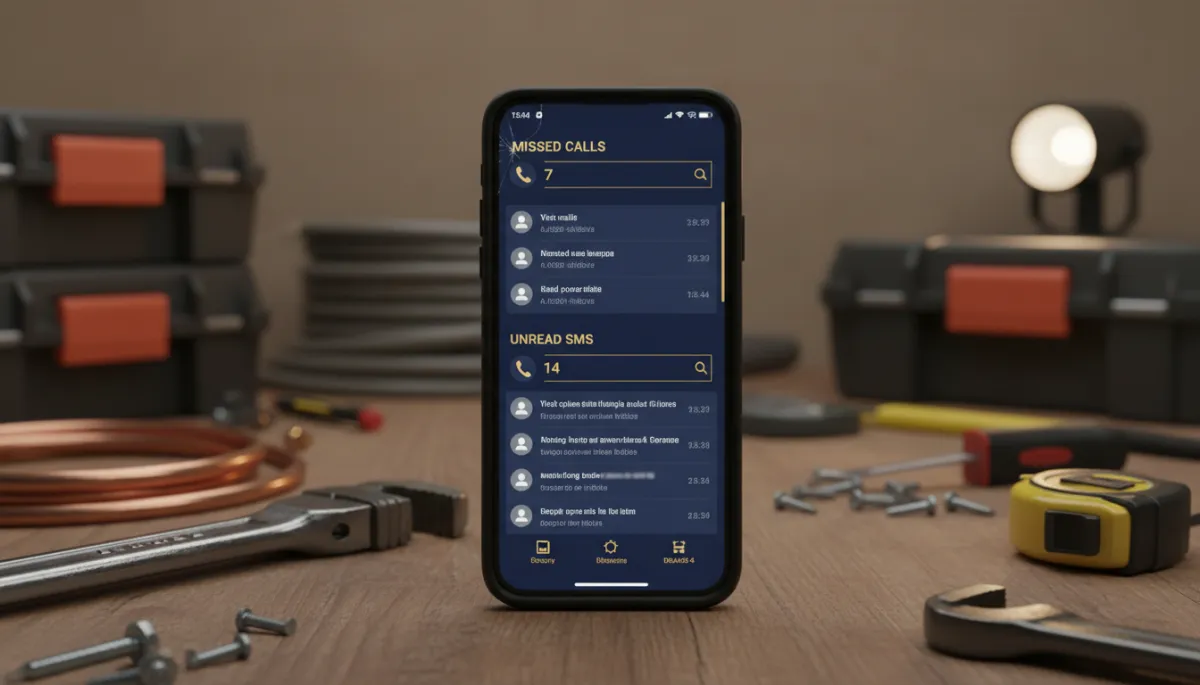
Close-up of a smartphone on a workbench in an Australian plumbing van, showing multiple missed...
Every unanswered call or slow reply is a potential job quietly going to a faster competitor.
Research on Australian tradies shows 30–40% of calls go unanswered during busy periods (backontools.com.au). Of those who hit voicemail, 62–80% never leave a message. They simply hang up and call the next tradie on Google. That is not a “maybe later” lead — that is gone for good.
One Gold Coast electrician missing just 3–5 calls per day, with an average job value of $1,300, was bleeding an estimated $342,000 per year in revenue (lucraai.com.au). That is the cost of being second to reply, or not replying at all. Scale that across HVAC maintenance contracts or plumbing emergencies and the numbers get ugly fast.
💡 Pro tip: If your gut says “we’re busy, we must be doing fine”, check your missed-call log and web enquiries for the last 30 days. That is where the truth is hiding.
What automatic text-back actually does (and why it works)
The good news: you do not need a call centre to hit the 1-minute response rule. You just need a properly set up automatic text-back system. This is the backbone of modern speed to lead for tradies in Australia.
Here is what automatic text-back does in plain terms:
When someone calls and you do not answer within a few rings, the system instantly sends an SMS from your business number.
The message is personalised and clear, for example: “Hi, it’s Jake from Northern Air & Electrical. I’m on a job right now but I’ve got your call. Reply with a few details and I’ll text or call you back within 15 minutes.”
If they text back, the system captures their details — name, suburb, job type, urgency — and logs it against a lead record.
You get a notification or a simple dashboard view so you can respond properly as soon as you are free, with all the info in front of you.
The psychology is simple. The customer now knows: you exist, you are real, and you care enough to respond immediately. That alone keeps them from calling the next tradie. You have effectively “held” the lead, even though you are still under a house or halfway across town.
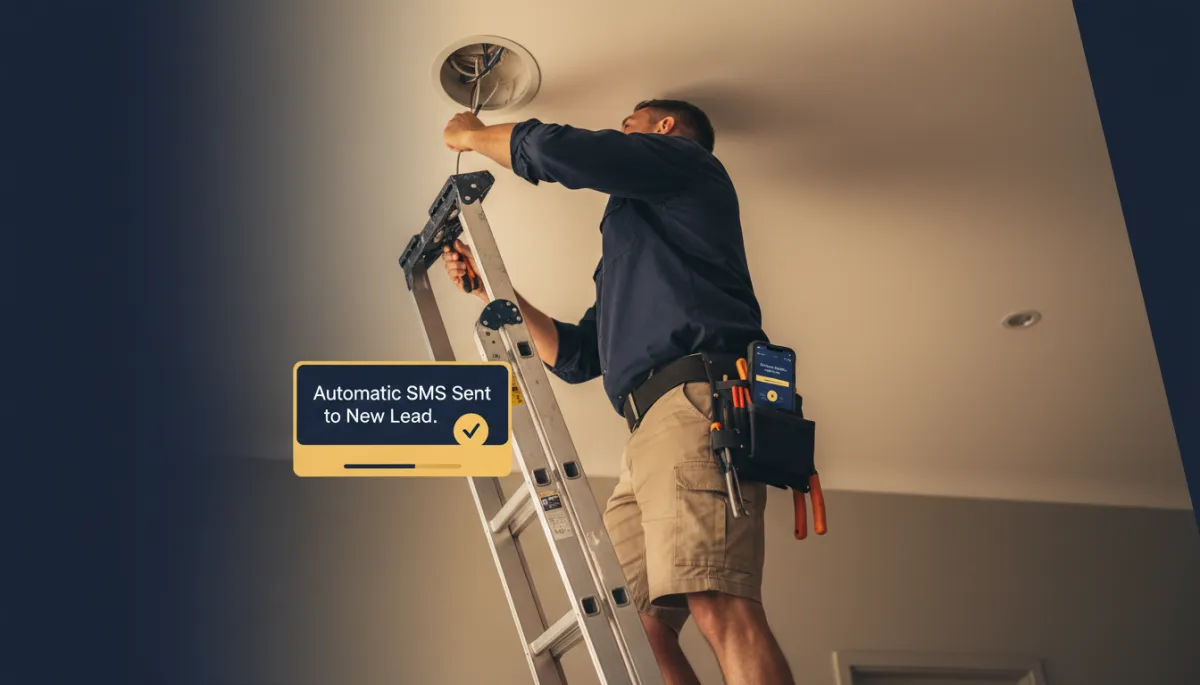
Scene of an Australian electrician on a ladder working on a ceiling light while their phone in a...
Automation replies in seconds so you can stay on the tools without losing the lead.
How automatic text-back fits into a full 60-second response system
Automatic SMS is the front line, but a proper 60-second response system ties your calls, website, and social enquiries together so no lead slips through the cracks. Here is what that looks like when it is done properly for HVAC, plumbing, and electrical contractors.
1. Capture every call instantly
Step one is making sure no call dies in voicemail. Your main business number routes through a call-handling system that can:
Detect unanswered calls after a set number of rings (say, 4–5).
Trigger an automatic text-back in under 10 seconds.
Optionally route to an AI or human answering service after hours for higher-value jobs or emergencies.
2. Turn web enquiries into live conversations
Standard contact forms convert at just 1–3% (leadkit.com.au). That is pathetic. A better approach is:
Use a short, mobile-friendly form that collects name, mobile, suburb, job type, and urgency.
As soon as the form is submitted, your system sends an SMS: “Got your enquiry about [burst pipe in Ashfield]. We’ll confirm details shortly. Reply with photos if you can.”
Their reply, plus any photos, feed straight into your lead record so you can price and prioritise quickly.
3. Prioritise and respond with intent — not panic
The goal is not to have you personally glued to your phone all day. The goal is to have a system that:
Logs every lead in one place — calls, texts, web, socials.
Labels urgency (e.g. “no hot water”, “power out”, “quote request for next month”).
Gives you or your office a simple queue to work through in order of value and urgency.
Because the initial touch is handled automatically, you can get back to leads in a controlled way — without them disappearing to the next tradie in the meantime. This is where the “first to reply wins the job” advantage is created. You are first, even when you are flat out.
4. Follow-up that runs without you
Many quotes go quiet not because the client is unhappy, but because life gets in the way. A basic follow-up sequence can convert an extra 15–25% of those “dead” quotes and add $12,000–$24,000 a year in revenue (tradiecard.au). Your 60-second response system should also:
Send a polite SMS 2 days after a quote: “Just checking in — any questions about the quote we sent for your ducted system?”
Nudge again at 5 and 10 days if there is still no response, then close the loop.
All of this can be automated. No one on your team needs to remember who to chase. The system does it and you bank the extra work.
Step-by-step: setting up a 60-second response system in your trade business
You do not need to rebuild your whole business to get this right. Here is a straightforward rollout path that works for HVAC, plumbing, and electrical contractors across Australia.
Step 1: Audit your current response reality
For one week, track:
How many calls you miss per day (your phone log will tell you).
How long it takes you to respond to each web or social enquiry.
How many of those missed calls and slow replies actually turn into jobs.
Put real numbers against the leak. That is your baseline and your motivation to fix it properly.
Step 2: Choose a central communication hub
Whether you are using ServiceM8, Tradify, simPRO, or a simple CRM, you need one system that:
Integrates with your phone number for missed-call SMS.
Can send and receive two-way SMS with clients.
Logs every enquiry as a lead or job, not just a message thread.
Step 3: Write tight, on-brand SMS templates
Do not wing it. Build a small library of SMS templates that sound like you, but are clear and professional. For example:
Missed-call reply: “Hi, it’s Sarah from Coastal Plumbing. I’ve got your call but I’m on a job. Reply with your suburb and what’s happening and I’ll get back to you shortly.”
Web enquiry reply: “Thanks for reaching out about your ducted system. We’ve received your details and will confirm options shortly. Reply with photos if you can.”
Keep them short, human, and focused on next steps. No fluff, no corporate jargon.
Step 4: Automate triggers and test in the real world
With the right system (or a specialist like CairnCore Systems), you then:
Set rules: “If call is missed, send Template A within 10 seconds.”
Set rules: “If web form is submitted, send Template B instantly and create a lead.”
Set rules: “If quote is sent and not accepted within 2 days, send Template C.”
Then you test. Call your own number from a mate’s phone, submit your own web form, and make sure everything fires within 60 seconds. Fix what is clunky before it goes live.
Step 5: Track the numbers and keep tuning
Once your 60-second response system is in place, watch:
How many missed calls now turn into text conversations and jobs.
How many web enquiries you are converting compared with before.
How your average response time drops — and your monthly revenue rises.
This is not a set-and-forget gimmick. It is an ongoing system that you tweak as your team grows, your pricing changes, and you move into new suburbs or services.
Ready to stop losing jobs to faster tradies?
If you are running an HVAC, plumbing, or electrical business in Australia and you are serious about growth, you cannot ignore speed to lead any longer. The data is clear: respond within a minute and you multiply your chances of winning the job. Keep doing what most trade contractors do — answering when you can, calling back “later”, hoping voicemail works — and you will keep leaking revenue to competitors who are simply faster.
CairnCore Systems works specifically with Australian tradies to design and implement done-for-you 60-second response systems using tools that fit how you already work. No tech headaches, no fluffy marketing talk — just practical automation that makes sure you are first to reply, every time, without you living on your phone.
If you want to stop being the second or third quote and start being the tradie who gets the call, the text, and the job, it is time to fix your response system properly.
👉 Book a free call with CairnCore Systems and we will walk you through exactly how a 60-second response system could work in your business — with real numbers, not hype. No pressure, no long sales pitch. Just a straight conversation about plugging the leaks and making sure that when someone needs a tradie, you are the first to reply and the first to win the job.
